The FDA wants to reduce animal testing. How do we see it, as a CRO that works with animal models every day?
18 / 11 / 2026 | Versa Biomedical

In April 2025, the US Food and Drug Administration (FDA) published a document that has shaped the debate on preclinical research: the Roadmap to Reducing Animal Testing in Preclinical Safety Studies. A year and a half later, with the first results now available, we would like to explain what it proposes, how it is evolving and how we see it at Versa.
What the FDA proposes and how it has progressed
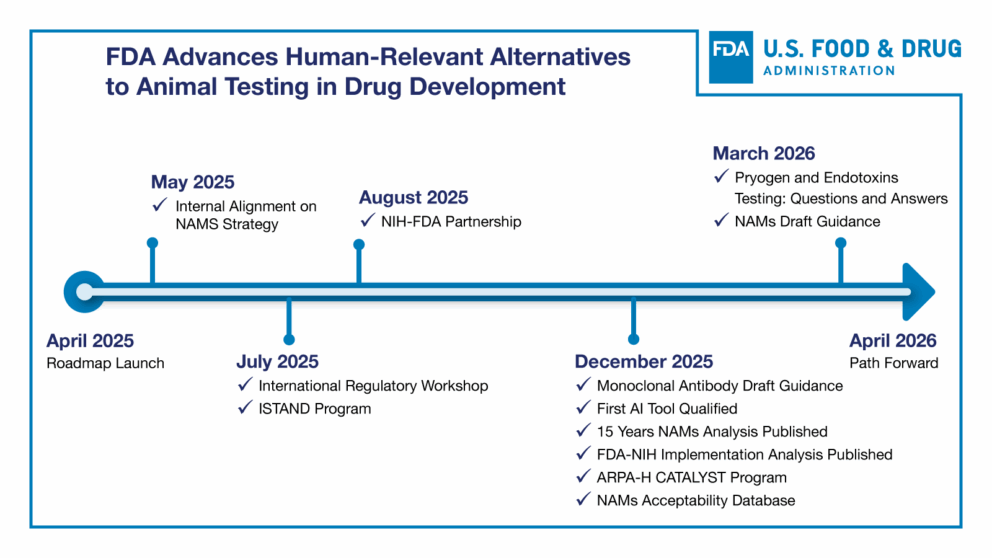
In April 2025, the FDA presented its roadmap to make animal testing the exception rather than the norm in preclinical safety studies. It focuses on New Approach Methodologies (NAMs): organ-on-a-chip systems, computational models, human tissues and human cell-based assays. It starts with monoclonal antibodies, where toxicity studies require large numbers of primates, and plans to extend gradually to other medicines. In parallel, the US National Institutes of Health (NIH) announced a new office to promote these methodologies in the research they fund.
One year on, the change is moving forward. The FDA has published draft guidance on how to validate NAMs and, in its progress report, highlights that it no longer requires six-month primate studies for monoclonal antibodies. At the same time, the scientific community points out that animal models are still needed in many areas, such as reproductive toxicity or long-term organ damage (FASEB; Lei et al., Stem Cell Research & Therapy). It is a real, gradual change that, for now, coexists with in vivo studies.
How we see it at Versa
We fully share the aim of this roadmap and are 100% committed to working in this direction. Replacing, reducing and refining the use of animals wherever possible is a principle we know well: in Europe, the 3Rs have been part of the legal framework for animal research since Directive 2010/63/EU, and they underpin how we design every study.
We also see the day-to-day reality first-hand. Today, in many cases, regulation still requires in vivo studies,. In those cases, our commitment is that every study has the right design and delivers the greatest possible scientific value, with animal welfare in mind from the very start.
In the field of medical devices, where we regularly work, this shift has also been under way for some time. The international standard ISO 10993, which governs the biological evaluation of medical devices, already favours in vitro methods and physical and chemical testing when they provide information as relevant as in vivo models (FDA guidance on ISO 10993-1).
Over more than 12 years and more than 200 projects with pig and cadaver models, we have learnt that every scientific question calls for its own model. New methodologies open up possibilities that we follow with great interest, and we believe the future of research lies in combining them with the models we already know.
A commitment that goes further
For us, animal welfare is a commitment of our own that goes beyond what the standards require. A few weeks ago, we achieved AAALAC International accreditation, a recognition we are especially pleased about because it reflects the way we have worked all these years.
Versa is an integrated biomedical platform supporting medical innovation, from early design to real-world adoption. We will keep a close eye on how the FDA roadmap evolves, with the same conviction as always: open, ad hoc models, designed so that every study delivers its full value.
Open models, open futures.